Why Ranking Pages Update Every Thursday
A ranking page that refreshes on a fixed day makes a promise about freshness, not about quality. The trends chart is a single batch of twenty cards that gets reordered once a week, so the list you looked at on Friday is never more than seven days stale — and when the counters were read on 22 September 2026, the leading card alone showed 24.3M views against 7.1K favourites.

Key takeaways
- Twenty cards, one refresh day. The weekly schedule is a deliberate batch decision, not a limitation of the counter.
- Each card shows two numbers — views and favourites. The leader read 24.3M and 7.1K, a ratio of roughly 0.029%.
- A fixed day makes browsing cheap: one visit a week replaces a dozen refreshes, and you can plan instead of waiting.
- Shortlists decay at each reorder, so anything worth keeping should be saved to a personal list the day you find it.
The cadence is the product decision
Ordering a catalogue by popularity can be done two ways. A live feed recomputes positions continuously and shows whatever is climbing at that second. A weekly chart freezes the order, recomputes it in one pass, and republishes. Both are rankings; only the second one tells you when it was built and roughly how long its verdict will stand.
The weekly version is friendlier to the person browsing. If you know the order changes on Thursday, you also know that checking on Wednesday gives you almost the same information as checking on Monday. That removes the small compulsion to peek repeatedly, which is exactly the behaviour a continuously reordered list encourages. On Crushon the schedule is stated plainly, and the same search page carries separate ladders for Creators and for characters, so the two kinds of maker are ranked against their own peers rather than mixed into one queue.
Builders get something from the cadence too. A weekly window is long enough for a new card to accumulate a visible number of views and short enough that a quiet week does not bury it permanently. Creators who publish on one Thursday can watch the next reorder and learn whether the change they made moved anything.
What actually changes between two Thursdays
The counters themselves never reset. Views and favourites accumulate on the card, so the figure you see is a lifetime total, not a weekly score. What the refresh changes is the order — a card that has been accumulating for months can sit below one that has been accumulating for weeks if the newer card is drawing attention faster.
That combination produces the most common misreading of any chart like this: treating the counter as a measure of current momentum. It is not. A card with 19.1M views and 2.8K favourites may be cooling while a card with 18.2M views and 4.7K favourites is still being discovered, and the only reason both appear near the top is that the ordering rule knows more than the two numbers printed on the card.
| Element | What the page shows | What it means when you are browsing |
|---|---|---|
| Refresh day | Weekly rankings republished on Thursday | Positions are a dated snapshot, so a Monday visit and a Wednesday visit tell you nearly the same thing |
| Chart length | Twenty NSFW AI characters on the trends page | The whole list is browsable in one sitting, which makes a weekly routine realistic |
| Counters per card | Views and favourites printed together | Two numbers let you compute a ratio instead of trusting a position |
| Attribution | Each card carries a creator credit | The refresh also reorders Creators, so a card and its maker can be tracked on two ladders |
| Filtering | Filtered, Unfiltered and 18+ options | The same weekly order can be read through different filters without changing the schedule |
Two ways a dated list misleads
The first is treating a position as a recommendation. A chart ordered by attention answers one question — what have the most people looked at lately — and leaves fit entirely out of the calculation. A card sitting at number three because a large audience found it appealing may have nothing in common with the tone, pacing or premise you actually enjoy reading.
The second is forgetting that the visible counters cover different lengths of time. A card published recently can rank above an older one while showing a smaller lifetime view total, simply because it accumulated its views faster. Two cards can look nearly equal in the chart and be moving in opposite directions. The fix in both cases is the same: read the ratio and the date, not the rank, and let a saved shortlist carry the memory that the reorder removes.
Worked example
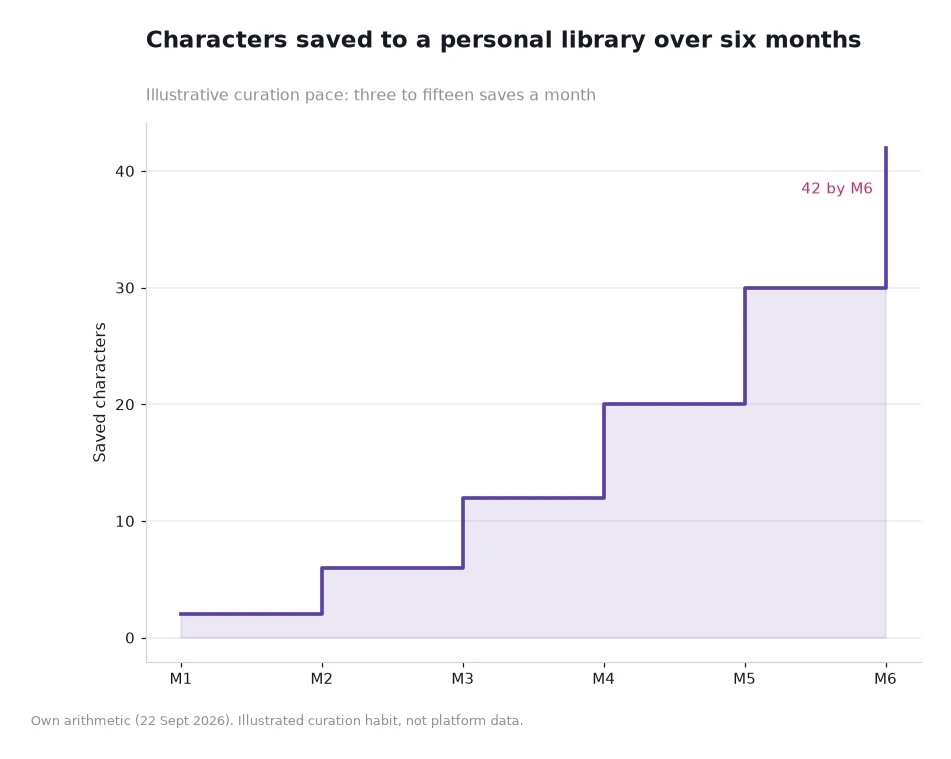
Suppose a reader treats Thursday as the only day they browse and saves whatever looks worth a second visit. The chart below plots a six-month library where the monthly additions are two, four, six, eight, ten and twelve characters — an illustrative pace, not platform data. The cumulative line runs 2, 6, 12, 20, 30 and 42.
Run the arithmetic line by line. Month one: 2 saves, cumulative 2. Month two: 2 + 4 = 6. Month three: 6 + 6 = 12. Month four: 12 + 8 = 20. Month five: 20 + 10 = 30. Month six: 30 + 12 = 42. Five of the six monthly steps — 4, 6, 8, 10 and 12 — sit inside the three-to-fifteen band the chart's subtitle uses to describe a typical curation pace; only the opening month, at two, falls below it. Spread across roughly 26 Thursdays, the same 42 saves work out at about 1.6 per week, which is a realistic amount to review properly rather than skim.
Turning the chart into a weekly routine
A dated list is easiest to use when your habit matches its period. Pick Thursday, open the nsfw ai chat chart, and spend the same fifteen minutes each week: read the twenty cards, note which ones moved more than a few places, and save anything you would want to find again. Because the order only changes once, there is nothing to gain from checking in between — the page will show you the same sequence from Friday morning.
Two habits make the routine stick. Use the character search page when a card you liked has dropped out of the twenty, since the chart is a snapshot and the catalogue underneath it is larger. And keep an eye on the separate weekly rankings for Creators if you follow particular authors, because a maker's standing can move for reasons a single card's counter will not reveal.
Frequently asked questions
Does the Thursday refresh reset the view counters?
No. Views and favourites accumulate on the card; the refresh changes the order in which cards are listed, not the totals printed on them.
Why not reorder the list continuously?
A continuous feed rewards constant checking. A weekly batch gives a stable order, publishes a clear date, and lets a reader plan a single visit.
How quickly can a new card appear in the chart?
It has to draw enough attention to be reordered into the top twenty, so the earliest realistic entry is the next refresh day rather than the moment it is published.
Pick one day and keep it
The practical argument for a fixed refresh day is attention, not novelty. Twenty cards reviewed once a week is a routine you can sustain; the same twenty cards checked every evening is a habit that quietly costs more than it returns. Choose a day, keep the visit short, and save what you intend to revisit so the reorder cannot take it away from you.
Evidence base: the trends page card counters and the weekly refresh note were read on the platform on 22 Sept 2026[1], and the six-month library figures are illustrative arithmetic rather than measured activity. All of it was read 22 Sept 2026. Written for an adult readership of 18 and over.