Developing a custom scent in a solid or oil format is two projects running together: the fragrance, which is a blend of aroma materials, and the base, which is the wax, butter or carrier that holds it. Founders who treat the second as packaging tend to be surprised at the end, when the scent they approved on a blotter performs differently in a stick. The walkthrough below follows a first order from brief to sealed unit, with the founder's responsibility at each stage kept explicit. Read it before the first call and the process becomes predictable rather than mysterious.
Key takeaways
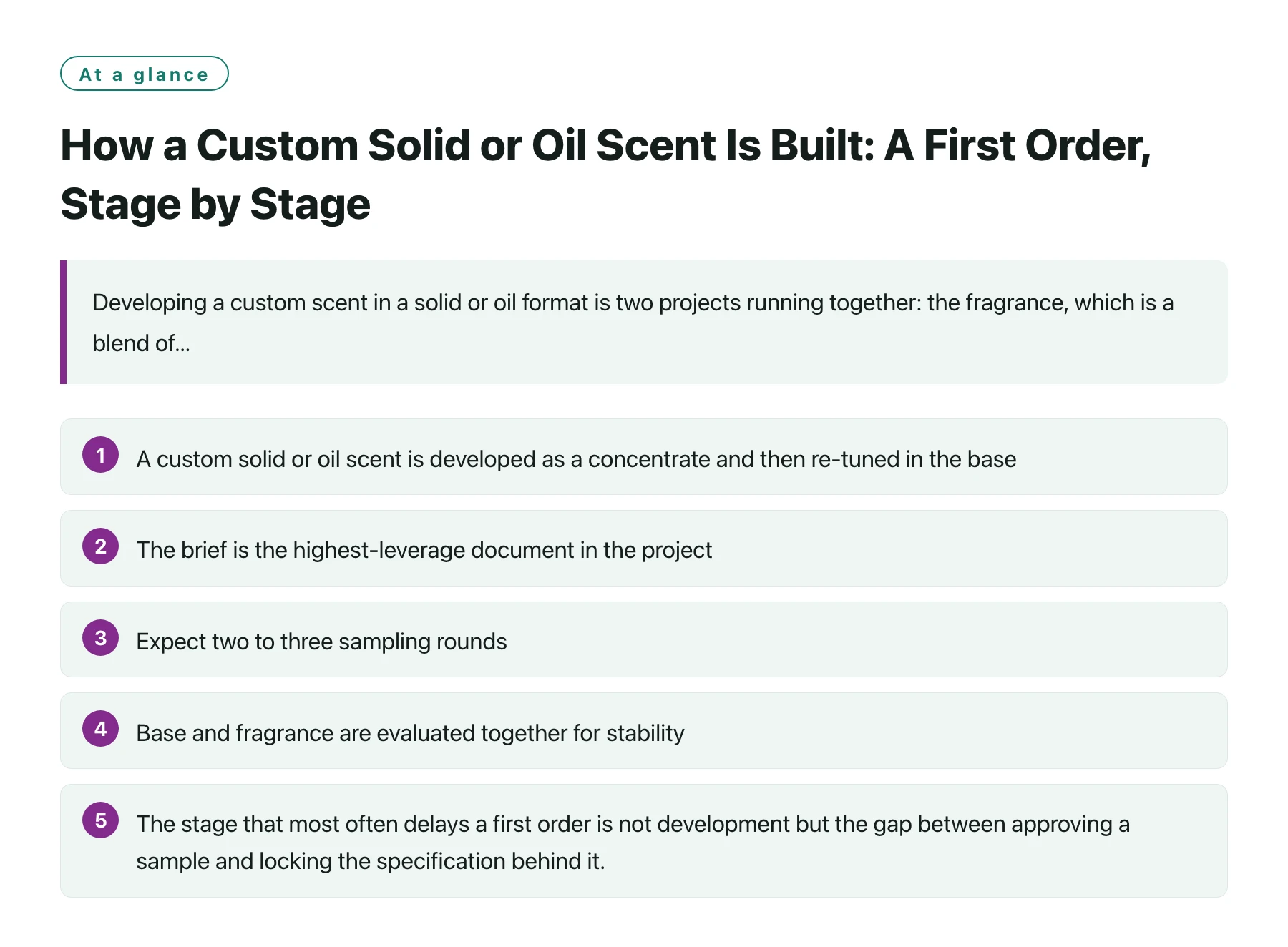
- A custom solid or oil scent is developed as a concentrate and then re-tuned in the base, so the approval that matters is on the finished format rather than on a blotter.
- The brief is the highest-leverage document in the project, because it defines the scent direction, the skin feel and the constraints the factory must design around.
- Expect two to three sampling rounds; each round should carry consolidated written comments rather than a stream of small corrections.
- Base and fragrance are evaluated together for stability, colour, odour drift and surface behaviour before any bulk commitment.
- The stage that most often delays a first order is not development but the gap between approving a sample and locking the specification behind it.
Most founders arrive at a custom development project with a reference: a scent they like, a mood, a market, or a competitor they want to sit near. None of those is a brief yet, and the first stage of the process is turning one of them into something a perfumer can work with.
A factory that develops custom scents runs two parallel tracks from that point. On one track, the perfumer builds and adjusts the concentrate. On the other, the base is selected or formulated so the concentrate can be carried, released and stored in the intended format.
The seven stages below describe what a first-time founder should expect from a typical first order. Durations vary, but the sequence rarely does.
Not every project starts from zero. A custom perfume factory will often suggest beginning with an existing base and adapting it, which shortens the screening stage without removing the perfumery work, and that suggestion is usually a sign of a supplier that has run the process before rather than one that has not.
The seven stages of a first custom project
- Stage 1: the written briefThe founder sets the scent direction, the product format, the fill weight, the fragrance load target, the market and the price ceiling. Anything left out here becomes an assumption the factory has to make, and assumptions are what the first sample round tests.
- Stage 2: base screeningThe factory proposes two or three base options that suit the brief, and builds a small sample of each with a simple version of the scent. This stage exists to eliminate the bases that cannot carry the direction before much perfumery time is spent.
- Stage 3: first concentrate and pairingThe perfumer builds the concentrate and pairs it with the selected base. The founder evaluates the finished format: how it opens, how it sits on skin, how it wears, and how the base feels. The blotter reading is a reference, not the decision.
- Stage 4: revision roundsComments are consolidated and returned. Two to three rounds is normal. Each round should change a small number of things so the founder can attribute the improvement, and each round should end with a written note of what changed.
- Stage 5: stability and compatibilityThe approved candidate goes into its final packaging and is held at room and elevated temperature, checked for weeping, bloom, separation, colour and odour drift. This is the stage that protects the product in storage and transit.
- Stage 6: specification lockFill weight, packaging, tolerance, reference sample and label content are fixed in writing. Until this happens, the project is still in development even if the sample appears perfect.
- Stage 7: bulk and releaseProduction runs against the locked specification, with retained references held by both sides and batch documents issued before the goods leave the factory.
What the founder supplies and approves at each stage
| Stage | What you supply | What you sign off |
|---|---|---|
| Brief | Scent direction, format, fill weight, load target, market, price ceiling, timeline. | The written brief, confirmed as the project baseline. |
| Base screening | Confirmation of skin feel and firmness priorities, and any ingredient exclusions. | The selected base direction, before concentrated perfumery work continues. |
| First pairing | Consolidated feedback on the finished sample, not only the scent. | The candidate to take into revision. |
| Revision rounds | One set of written comments per round, with priorities marked. | The candidate to freeze for stability testing. |
| Stability and compatibility | Shipping and storage conditions the product will face, including climate. | The test protocol, and the result against it. |
| Specification lock | Confirmation of label content, fill weight and packaging. | The sealed reference sample and the written specification. |
| Bulk and release | Purchase order and any market-specific document requirements. | The batch documents and the release of the shipment. |
The founder's workload is front-loaded: the brief and the approval decisions determine most of the outcome, while the factory's work is concentrated in the middle stages.
Where the scent itself comes from
A perfumer builds a concentrate from aroma materials, and the vocabulary that describes them is largely a vocabulary of families and materials rather than of single ingredients. Understanding that structure helps a founder give useful feedback, because a comment such as too sweet in the opening is actionable while a comment such as not quite right is not.
Reference material is widely available in public form. Databases and reference works describe how individual materials smell and where they sit in a composition, and a founder who spends an evening with one of them usually briefs noticeably better the next day [2]. Background reading on the chemistry of aroma compounds is a further step for anyone who wants to understand why some materials dominate a blend and others vanish within minutes [3].
The general history and structure of perfumery is well documented as well, and it is worth knowing that the familiar division into top, heart and base notes is a description of volatility rather than a rule the formula must follow [1]. In a solid or oil format those divisions behave differently anyway, because the base slows release and flattens the opening.
What changes in a solid or oil format
In a spray, the alcohol evaporates and the scent blooms quickly. In a solid or oil, the base holds the fragrance and releases it slowly, so the opening is quieter and the tail is longer. Founders often describe the first solid sample as weaker than expected; it usually is not weaker, it is differently shaped.
The base also constrains the load. Push the fragrance too high in a stick and the structure softens, weeps or blooms; in an oil, the product can feel heavy or leave a film. The realistic load range is a property of the base, which is why base screening belongs before perfumery refinement rather than after it.
Odour perception changes too. Wax and carrier oils have their own faint smell, and a note that reads cleanly on a blotter can pick up a waxy character in the stick. Evaluating the finished format over an hour, on skin, is the only way to catch that.
None of this makes these formats harder to develop; it makes them harder to judge from a blotter. Trade coverage of solid and anhydrous products has grown as brands look for travel-friendly and alcohol-free options, and the common thread in that coverage is that format and fragrance have to be designed together [4].
There is one further resource worth using if it is available. A manufacturer that also runs a museum built around smell usually keeps a large reference collection, and comparing your candidate against dozens of existing compositions in one sitting is a different exercise from judging it in isolation a museum built around smell.
Before the first call, write down three reference scents, the market you are selling into, the fill weight you are aiming for, and the price ceiling per unit. Those four facts remove most of the guesswork from the first sample round, and they cost nothing to prepare.
How to keep the project on schedule
The most common delay in a first custom project is not development; it is the interval between a founder deciding they like a sample and the specification being written down. Every week spent in that gap is a week the schedule cannot recover later, because bulk production depends on a locked specification.
If the development is happening abroad, a visit is worth more than several email rounds. Smelling the candidate on skin, in the climate it will be sold in, and watching it being filled tells you things a photograph cannot, and a perfume factory in Guangzhou that hosts clients will normally build that visit into the development calendar the perfume factory in Guangzhou.
A useful habit is to treat each sample round as a decision rather than an impression. Decide what you are evaluating before the sample arrives, note it in writing within a day or two, and send one consolidated reply. A perfumer can act on a clear list; they cannot act on a sequence of half-remembered comments.
It also helps to choose a partner whose development process is visible from the outside. A factory that presents itself as a scent development and manufacturing partner should be able to describe its own stage sequence and say where your project currently sits in it, which is a reasonable question to ask before the first invoice scent development and manufacturing partner.
Sources
- Wikipedia: Perfume —— An encyclopaedic overview of perfume covering definitions, history, the note structure of a fragrance and concentration terminology (background reference only).
- The Good Scents Company —— A reference database of aroma materials with odour descriptions, CAS numbers and typical usage information.
- Chemistry World (Royal Society of Chemistry) —— The Royal Society of Chemistry's magazine, covering chemistry research and explanations of everyday materials including aroma compounds.
- Cosmetics & Toiletries —— A technical magazine for cosmetic formulators, covering ingredients, formulation science and testing methods.
Frequently asked questions
Can I develop a custom solid fragrance from a scent I already sell as a spray?
Yes, and the concentrate can usually be reused, but the result will not smell identical. The base changes release, projection and the opening, so the formula normally needs adjustment. Budget at least one additional sampling round for the transfer.
How many sample rounds should I expect on a first project?
Two to three rounds is typical for a first custom scent in a new format. More than that usually means the brief was unclear or feedback was fragmented, both of which are cheaper to fix at the start than in round five.
Should I approve a sample on a blotter or on skin?
Always on skin, in the finished base and packaging. A blotter tells you what the concentrate smells like; it does not tell you how the wax, carrier or rollerball delivery changes the first ten minutes or the third hour.
Who decides the fragrance load?
It is a joint decision. The founder sets the target performance and cost, and the factory confirms what the base can carry without softening, weeping or exceeding the applicable material restrictions. If the two do not agree, the base usually changes rather than the target.
What should I receive at the end of development?
A locked specification, a sealed reference sample held by both sides, a stability and compatibility report, and the label data needed for the ingredient and allergen list. If any of those four is missing, ask for it before the bulk order is placed.